

HPE7-A01 Study Guide: Latest [Oct 03, 2026] Realistic Verified HPE7-A01 Dumps
HPE7-A01 Questions & Practice Test are Available On-Demand
NEW QUESTION # 95
A customer is concerned about me unprotected traffic between an AOS-CX switch and a gateway, running on AOStO. What is a feasible option to protect this traffic?
- A. no action is needed, an RSA certificate already encrypts the traffic
- B. Implement an IPSec tunnel to protect PAPI between the AOS-CX switches and the gateway
- C. Implement an MD5 HMAC function lo protect PAPI between the AOS-CX switches and the gateway
- D. Implement a GRE tunnel to protect PAPI between the AOS-CX switches and the gateway
Answer: B
Explanation:
According to the Aruba Documentation Portal1, PAPI (Port Aggregation Protocol) is a protocol that allows multiple physical ports to be aggregated into a single logical port for increased bandwidth and performance.
PAPI can be used between AOS-CX switches and gateways, or between AOS-CX switches and other devices.
Option A: Implement an IPSec tunnel to protect PAPI between the AOS-CX switches and the gateway This is because option A shows how to implement an IPSec tunnel between two devices using the interface command and the ipsec command. An IPSec tunnel can provideencryption and authentication for PAPI traffic between two devices, such as an AOS-CX switch and a gateway2.
Therefore, option A is a feasible option to protect this traffic.
I hope this helps you. If you need more information, please let me know.
1:
https://www.arubanetworks.com/techdocs/AOS-CX/10.06/HTML/5200-7727/Content/Chp_prev_traf_loss/Act_g
https://community.arubanetworks.com/blogviewer?blogkey=989fc43a-e0df-42db-9c0b-f96d6565a1fa
NEW QUESTION # 96
Due to a shipping error, five (5) Aruba AP-515S and one (1) Aruba CX 6300 were sent directly to your new branch office. You have configured a new group persona for the new branch office devices in Central, but you do not know their MAC addresses or serial numbers. The office manager is instructed via text message on their smartphone to onboard all the new hardware into Aruba Central.
What application must the office manager use on their phone to complete this task?
- A. Aruba installer App
- B. Aruba Onboard App
- C. Aruba Central App
- D. Aruba CX Mobile App
Answer: C
Explanation:
Aruba Central is a cloud-based networking solution that empowers IT with AI-powered insights, intuitive visualizations, workflow automation, and edge-to-cloud security to manage campus, branch, remote, data center, and IoT networks from one dashboard. Aruba Central also provides a mobile app that allows users to easily onboard and monitor devices. The app enables users to scan the barcode of a device (such as an AP or a switch) and add it to their network in Aruba Central. The app also lets users monitor the details of Aruba wireless access points and switches and their clients on their network. Therefore, the application that the office manager must use on their phone to complete the task of onboarding all the new hardware into Aruba Central is the Aruba Central App.
NEW QUESTION # 97
Your Director of Security asks you to assign AOS-CX switch management roles to new employees based on their specific job requirements After the configuration was complete, it was noted that a user assigned with the administrators role did not have the appropriate level of access on the switch.
The user was not limited to viewing nonsensitive configuration information and a level of 1 was not assigned to their role Which default management role should have been assigned for the user?
- A. operators
- B. sysadmin
- C. config
- D. helpdesk
Answer: A
Explanation:
The default management role that should have been assigned for the user is B. operators.
The operators user role is a predefined role that allows users to view nonsensitive configuration information on the switch, such as interfaces, VLANs, routing protocols, statistics, and more. The operators user role has a privilege level of 1, which is the lowest level of access on the switch1.
The administrators user role is a predefined role that has full access to all switch configuration information and all REST API methods. This role is more than what the Director of Security requires1.
NEW QUESTION # 98
Which statements are true regarding a VXLAN implementation on Aruba Switches? (Select two.)
- A. VTEPs encapsulate and decapsulate VXLAN traffic
- B. VNIs encapsulate and decapsulate VXLAN traffic
- C. They are only available for datacenter switches (CX 8k, 9k,10k)
- D. All Aruba CX switches support VXLAN.
- E. MTU size must be increased beyond the default
Answer: A,E
Explanation:
Option A: MTU size must be increased beyond the default
This is because option A shows how to configure the MTU size for VXLAN tunnels on Aruba switches using the interface command and the vxlan command. The MTU size must be increased beyond the default value of 1500 bytes to accommodate the VXLAN header and payload2.
Therefore, option A is true regarding a VXLAN implementation on Aruba switches. Option B: VNIs encapsulate and decapsulate VXLAN traffic This is also true regarding a VXLAN implementation on Aruba switches. VNIs are used to encapsulate and decapsulate VXLAN traffic between two devices, such as a switch and a server. VNIs are also used to map VXLAN tunnels to overlay networks3.
Therefore, option B is also true regarding a VXLAN implementation on Aruba switches.
VXLAN is a Layer 2 encapsulation technology that substitutes the usage of VLAN numbers to label Ethernet broadcast domains with VXLAN numbers. VXLAN supports 224 Ethernet broadcast domains or VXLAN numbers. A VXLAN number ID is referred to as VNI. There is a one-to-one relationship between an Ethernet broadcast domain and a VNI. A single Ethernet broadcast domain can't have more than one VNI.
NEW QUESTION # 99
Which method is used to onboard a new UXI in an existing environment with 802 1X authentication? (The sensor has no cellular connection)
- A. Use the Aruba installer app on your smartphone to scan the barcode
- B. Use the UXI app on your smartphone and connect the UXI via Bluetooth
- C. Connect the new UXI from an already installed one and adjust the initial configuration.
- D. Use the CLI via the serial cable and adjust the initial configuration.
Answer: B
Explanation:
Explanation
To onboard a new UXI in an existing environment with 802.1X authentication, you need to use the UXI app on your smartphone and connect the UXI via Bluetooth. The UXI app allows you to scan the QR code on the UXI sensor and configure its network settings, such as SSID, password, IP address, etc. The Bluetooth connection allows you to communicate with the UXI sensor without requiring any network access or cellular connection. The other options are incorrect because they either do not use the UXI app or do not use Bluetooth. References:
https://www.arubanetworks.com/products/network-management-operations/analytics-monitoring/user-experienc
https://help.centralon-prem.arubanetworks.com/2.5.4/documentation/online_help/content/nms-on-prem/aos-cx/g
NEW QUESTION # 100
What does the 802.3bz standard describe?
- A. 60 W and 90W PoE
- B. 2.5Gb and 5Gb Ethernet ports
- C. 60 GHz P2P Wi-Fi
- D. AP directed roaming between APs
Answer: B
Explanation:
802.3bz is a standard for Ethernet over twisted pair at speeds of 2.5 and 5 Gbit/s. These use the same cabling as the ubiquitous Gigabit Ethernet, yet offer higher speeds. The resulting standards are named 2.5GBASE-T and 5GBASE-T.
NEW QUESTION # 101
Match the appropriate QoS concept with its definition. (Options may be used more than once or not at all.)
Answer:
Explanation:
Explanation: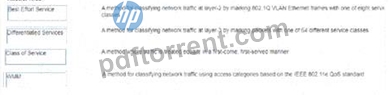
QoS concept: Class of Service Definition: 3) A method for classifying network traffic using access categories based on the IEEE 802.11e QoS standards QoS concept: Differentiated services Definition: 2) A method for classifying network traffic at layer-3 or marking packets with one of 64 different service classes QoS concept: WMM Definition: 4) A method for classifying network traffic using access categories based on the IEEE 802.11e QoS standards
NEW QUESTION # 102
When configuring UBT on a switch what will happen when a gateway role is not specified?
- A. The switch will put the client on the access VLAN
- B. The gateway will send back the deny role to the client.
- C. The switch will assign the default deny role to the client.
- D. The gateway will assign a default role to the client
Answer: A
Explanation:
According to the Aruba Documentation Portal1, user-based tunneling (UBT) is a feature that uses GRE to tunnel ingress traffic on a switch interface to a gateway for further processing. UBT enables a switch to provide a centralized security policy, using per-user authentication and access control to ensure consistent access and permissions.
Option A: The switch will put the client on the access VLAN
This is because option A shows how UBT works on an Aruba switch. When a device connects to the network, it is authenticated using either MAC Authentication or 802.1X and triggers an enforcement policy from ClearPass, which contains an enforcement profile with a user role configuration. The user role can be assigned locally on the switch or on ClearPass as part of an enforcement profile. The user role determines the VLAN that the device belongs to and the access policies that apply to it23.
Therefore, option A is correct.
1: https://www.arubanetworks.com/techdocs/central/latest/content/nms/aos-cx/cfg/conf-cx-ubt.htm 2: https://www.arubanetworks.com/techdocs/AOS-CX/10.06/HTML/5200-7696/GUID-581D2976-694B-46C7-8497-F6B788AA05B2.html 3: https://community.arubanetworks.com/viewdocument/?DocumentKey=c740df4e-3e26-4cc5-9126-355a18709c44&CommunityKey=2fd943a6-8898-4dbe-915f-4f09e4d3c317&tab=librarydocuments
NEW QUESTION # 103
A company recently deployed new Aruba Access Points at different branch offices Wireless 802.1X authentication will be against a RADIUS server in the cloud. The security team is concerned that the traffic between the AP and the RADIUS server will be exposed.
What is the appropriate solution for this scenario?
- A. Configure RadSec on the AP and Aruba Central.
- B. Configure RadSec on the AP and the RADIUS server
- C. Enable EAP-TTLS on all wireless devices.
- D. Enable EAP-TLS on all wireless devices
Answer: B
Explanation:
This is the appropriate solution for this scenario where wireless 802.1X authentication will be against a RADIUS server in the cloud and the security team is concerned that the traffic between the AP and the RADIUS server will be exposed. RadSec, also known as RADIUS over TLS, is a protocol that provides encryption and authentication for RADIUS traffic over TCP and TLS. RadSec can be configured on both the AP and the RADIUS server to establish a secure tunnel for exchanging RADIUS packets. The other options are incorrect because they either do not provide encryption or authentication for RADIUS traffic or do not involve RadSec.References:
https://www.securew2.com/blog/what-is-radsec/https://www.cloudradius.com/radsec-vs-radius/
NEW QUESTION # 104
You need to create a keepalive network between two Aruba CX 8325 switches for VSX configuration How should you establish the keepalive connection?
- A. loopback 0 and OSPF area 0 in default VRF
- B. routed port in custom VRF
- C. SVI, VLAN trunk allowed all on ISL in custom VRF
- D. SVI, VLAN trunk allowed all on ISL in default VRF
Answer: B
Explanation:
To establish a keepalive connection between two Aruba CX 8325 switches for VSX configuration, you need to use a routed port in custom VRF. A routed port is a physical port that acts as a layer 3 interface and does not belong to any VLAN. A custom VRF is a virtual routing and forwarding instance that provides logical separation of routing tables. By using a routed port in custom VRF, you can isolate the keepalive traffic from other traffic and prevent routing loops or conflicts. The other options are incorrect because they either do not use a routed port or do not use a custom VRF. Reference: https://www.arubanetworks.com/techdocs/AOS-CX/10.04/HTML/5200-6728/bk01-ch07.html https://www.arubanetworks.com/techdocs/AOS-CX/10.04/HTML/5200-6728/bk01-ch02.html
NEW QUESTION # 105
In an ArubaOS 10 architecture using an AP and a gateway, what happens when a client attempts to join the network and the WLAN is configured with OWE?
- A. The Gateway will not respond.
- B. RADIUS protocol is utilized.
- C. Authentication information is not exchanged
- D. No encryption is applied.
Answer: C
Explanation:
This is the correct statement about what happens when a client attempts to join the network and the WLAN is configured with OWE (Opportunistic Wireless Encryption). OWE is a standard that provides encryption for open networks without requiring any authentication or credentials from the client or the network. OWE uses a Diffie-Hellman key exchange mechanism to establish a secure session between the client and the AP without exchanging any authentication information. The other options are incorrect because they either describe scenarios that require authentication or encryption methods that are not used by OWE.References:
https://www.arubanetworks.com/assets/wp/WP_WiFi6.pdfhttps://www.arubanetworks.com/assets/ds/DS_AP510
NEW QUESTION # 106
Which method is used to onboard a new UXI in an existing environment with 802 1X authentication? (The sensor has no cellular connection)
- A. Use the Aruba installer app on your smartphone to scan the barcode
- B. Use the UXI app on your smartphone and connect the UXI via Bluetooth
- C. Connect the new UXI from an already installed one and adjust the initial configuration.
- D. Use the CLI via the serial cable and adjust the initial configuration.
Answer: B
Explanation:
To onboard a new UXI in an existing environment with 802.1X authentication, you need to use the UXI app on your smartphone and connect the UXI via Bluetooth. The UXI app allows you to scan the QR code on the UXI sensor and configure its network settings, such as SSID, password, IP address, etc. The Bluetooth connection allows you to communicate with the UXI sensor without requiring any network access or cellular connection. The other options are incorrect because they either do not use the UXI app or do not use Bluetooth. References:
https://www.arubanetworks.com/products/network-management-operations/analytics-monitoring/user-experienc
NEW QUESTION # 107
Which statement best describes QoS?
- A. Identifying the quality of the connection
- B. Identifying specific traffic for special treatment
- C. Determining which traffic passes specified quality metrics
- D. Scoring traffic based on the quality of the contents
Answer: B
Explanation:
QoS stands for Quality of Service and is a mechanism that allows network devices to prioritize and differentiate traffic based on certain criteria, such as application type, source, destination, etc3. QoS involves identifying specific traffic for special treatment and applying policies and actions to improve its performance or meet certain service level agreements (SLAs)3. QoS can help network devices to manage congestion, delay, jitter, packet loss, bandwidth allocation, etc., for different types of traffic3.
QoS can be implemented at various layers of the network stack and across different network domains.
References: https://www.cisco.com/c/en/us/td/docs/ios-xml/ios/qos/configuration/15-mt/qos-15-mt- book/qos-overview.html
NEW QUESTION # 108
What does the 802.3bz standard describe?
- A. 60 W and 90W PoE
- B. 2.5Gb and 5Gb Ethernet ports
- C. 60 GHz P2P Wi-Fi
- D. AP directed roaming between APs
Answer: B
Explanation:
802.3bz is a standard for Ethernet over twisted pair at speeds of 2.5 and 5 Gbit/s. These use the same cabling as the ubiquitous Gigabit Ethernet, yet offer higher speeds. The resulting standards are named 2.5GBASE-T and 5GBASE-T.
Option A: 2.5Gb and 5Gb Ethernet ports
This is because option A shows how to identify the speed of an Ethernet port based on its name and the standard it supports. A port that supports 2.5GBASE-T or 5GBASE-T is a multi-gigabit port that can operate at speeds of up to 2.5 Gbit/s or 5 Gbit/s over twisted pair cables23.
Therefore, option A is correct.
1: https://en.wikipedia.org/wiki/2.5GBASE-T_and_5GBASE-T 2:
https://kb.netgear.com/000049004/What-is-Multi-Gigabit-Ethernet-and-how-can-I-benefit-from-using-NETGEA
https://arstechnica.com/gadgets/2016/09/5gbps-ethernet-standard-details-8023bz/
NEW QUESTION # 109
The administrator notices that wired guest users that have exceeded their bandwidth limit are not being disconnected Access Tracker in ClearPass indicates a disconnect CoA message is being sent to the AOS-CX switch.
An administrator has performed the following configuration
What is the most likely cause of this issue?
- A. There is a time difference between the switch and the ClearPass Policy Manager
- B. There is a mismatch between the RADIUS secret on the switch and CPPM.
- C. The SSL certificate for CPPM has not been added as a trust point on the switch
- D. Change of Authorization has not been globally enabled on the switch
Answer: D
Explanation:
Change of Authorization (CoA) is a feature that allows ClearPass Policy Manager (CPPM) to send messages to network devices such as switches to change the authorization state of a user session. CoA requires that both CPPM and the network device support this feature and have it enabled. For AOS-CX switches, CoA must be globally enabled using the command radius-server coa enable. If CoA is not enabled on the switch, the disconnect CoA message from CPPM will be ignored and the user session will not be terminated.
NEW QUESTION # 110
A customer is using Aruba Cloud Guest, but visitors keep complaining that the captive portal page keeps coming up after devices go to sleep.
Which solution should be enabled to deal with this issue?
- A. Wireless Caching under the splash page
- B. MAC Caching under the splash page
- C. MAC Caching under the user-role
- D. MAC Caching under the WLAN
Answer: D
Explanation:
This is the correct solution to deal with the issue where visitors keep complaining that the captive portal page keeps coming up after devices go to sleep. MAC Caching is a feature that allows an Aruba Access Point to bypass authentication for devices that have already been authenticated by a captive portal. MAC Caching can be enabled under the WLAN settings in Aruba Cloud Guest by selecting the MAC Caching checkbox and specifying the MAC Caching duration. The other options are incorrect because they either do not exist or do not apply to Aruba Cloud Guest.
NEW QUESTION # 111
Which feature allows the device to remain operational when a remote link failure occurs between a Gateway cluster and a RADIUS server that is either in the cloud or a datacenter?
- A. MAC Authentication
- B. MAC caching
- C. Opportunistic key caching
- D. Authentication survivability
Answer: D
Explanation:
Authentication survivability is a feature that allows the device to remain operational when a remote link failure occurs between a Gateway cluster and a RADIUS server that is either in the cloud or a datacenter.
Authentication survivability enables the Gateway cluster to cache successful authentication requests from the RADIUS server and use them to authenticate clients when the RADIUS server is unreachable. Authentication survivability also allows clients to use MAC caching or MAC authentication bypass (MAB) methods to access the network when the RADIUS server is down.References:https://www.arubanetworks.com/assets/tg/TG_AuthSurvivability.pdf
NEW QUESTION # 112
With the Aruba CX 6000 24G switch with uplinks of 1/1/25 andwhat does the switch do when a client port detects a loop and the do-not-disabie parameter is used?
- A. An event log message is created.
- B. Port status led blinks in amber with 100hz.
- C. Port status will be validated once status is cleared
- D. The network analytics engine is triggered.
Answer: A
Explanation:
The correct answer is B. An event log message is created.
The do-not-disable parameter is used to prevent the switch from disabling the port when a loop is detected by the loop-protect feature. Instead, the switch will generate an event log message that indicates the port number and the VLAN ID where the loop was detected.The switch will also send a trap to the SNMP manager, if configured1.
The other options are incorrect because:
* A. Port status will not be validated once status is cleared.The port will remain enabled even if a loop is detected, unless the loop-protect action is changed to tx-disable or tx-rx-disable1.
* C. The network analytics engine will not be triggered by a loop detection.The network analytics engine
* is a feature that allows users to monitor and troubleshoot network issues using scripts and agents2.
* D. Port status LED will not blink in amber with 100Hz.The port status LED will indicate the normal port status, such as link speed and activity, regardless of the loop detection3.
NEW QUESTION # 113
With the Aruba CX switch configuration, what is the Active Gateway feature that is used for and is unique to VSX configuration?
- A. VRID is set automatically as SVI vlan id
- B. VRRP and Active gateway are mutually exclusive on a VLAN
- C. VRRP and Active Gateway can be configured on a single VLAN for interoperability
- D. VRIDs need to be non-overlapping with VRRP
Answer: B
Explanation:
Active gateway is a first hop redundancy protocol that eliminates a single point of failure. The active gateway feature is used to increase the availability of the default gateway servicing hosts on the same subnet. An active gateway improves the reliability and performance of the host network by enabling a virtual router to act as the default gateway for that network. If you have enabled active gateway, VRRP is not required3. Active gateway is similar to VRRP in that routed traffic from the VSX node is sourced from the switch interface MAC and not the virtual MAC address (VMAC). Each active gateway sends a periodic broadcast hello packet to avoid VMAC aging on the access switches. The switch views the active gateway IP as a self IP address3. Active gateway is preferable over VRRP because with VRRP traffic is still pushed over the ISL link, resulting in latency in the network3. Therefore, VRRP and active gateway are mutually exclusive on a VLAN, and answer A is correct.
References: 1: Aruba Campus Access documents and learning resources 3: Active gateway over VSX - Aruba
NEW QUESTION # 114
......
Valid HPE7-A01 Exam Dumps Ensure you a HIGH SCORE: https://pass4sure.pdftorrent.com/HPE7-A01-latest-dumps.html